Card Name | Annual Fee | Best for | Rewards & Features | APR | ||
|---|---|---|---|---|---|---|
 | Capital on Tap Free Rewards Card | £0 | Companies wanting a no-fee all-rounder with strong cashback and good spend management controls |
| Rates as low as 13.86% APR (variable) | |
| Funding Circle Cashback Credit Card | £0 | Companies looking to maximise cashback rewards without paying an annual card fee |
| Rates as low as 14.9% APR (variable) | |
| Capital on Tap Pro | £299 | Companies / Directors that can spend £30k+ on cards annually and want premium travel rewards |
| Rates as low as 13.86% APR (variable) | |
 | Moss Business Credit Card | Custom | Scaling SMEs and finance teams managing company-wide spend |
| 0% (Charge card with balance paid in full monthly) | |
 | The American Express Business Gold Card | £195 pa (free 1st year) | Sole traders or company directors looking to boost their travel rewards for one year before annual fees are due. |
| N/A (Charge Card) | |
Capital on Tap is one of the UK’s largest fintech lenders, with over 200,000 small business customers. It’s a useful counterweight to high street bank business cards: credit decisions are made in roughly two minutes, the application is run via a soft search on your personal credit file, and there’s no requirement to hold a current account with the issuer.
The free card carries no annual, FX or ATM fees and earns uncapped 1% cashback on every transaction. They offer a credit limit up to £250,000, which is materially higher than most bank-issued business cards (Lloyds, RBS and Bank of Scotland all cap out at £25,000 for SMEs without bespoke arrangements).
Capital on Tap accepts only Ltd, LLP and PLC entities, so sole traders need to look elsewhere.
Our view: The default choice for any UK limited company that wants a free, no-friction business Visa card with a meaningful credit facility. Best paired with an Amex for businesses chasing premium rewards.
- Best for: Best for cashback rewards while remaining free
- Intro Offer: None
- Rewards:
- Uncapped 1% cashback on all card spending (including preloaded spend)
- Convert points to Avios at 10:8 via The British Airways Club or Qatar Airways Privilege Club
- Convert points to Virgin Points at 10:8
- Convert points to Radisson Rewards (poor rate, not recommended)
- Redeem points for cash, gift cards or against your balance
- Discounts on popular business software including Sage and Slack
- Interest-free period: Up to 42 days if the balance is repaid in full
- Annual Fee: None
- Purchase Rate: 36.19%
- Representative APR: 36.19% (variable) with rates as low as 13.86% APR (variable)
- Features:
- Up to £250,000 credit limit
- No FX or ATM fees
- Soft credit search at application
- Decision in around 2 minutes with a virtual card issued on approval
- Unlimited free employee cards with individual spend limits and real-time tracking
- Preloading available to spend beyond your credit limit
- Sync with Sage, Xero, QuickBooks and FreeAgent
- Eligibility:
- Active director or majority shareholder (25%+) resident in the UK
- Ltd company, LLP or PLC registered at Companies House
- No unsatisfied CCJs in the past 12 months (you or the business)
- Turnover of at least £24,000 per year (£2,000 per month)
Pros:
- No annual fee, FX fees or ATM fees
- Uncapped 1% cashback on every purchase
- Soft credit search at application
- Strong accounting software integration
- Instant decision and virtual card on approval
- Materially higher credit limit than most bank-issued SME cards (up to £250,000)
Cons:
- No sign-up bonus
- Avios / Virgin Points earn rate (10:8) is lower than on the Pro card (1:1)
- Sole traders are not accepted
- No sign-up bonus
- High representative APR if the balance isn’t cleared monthly
- Less suited to international travel rewards (see Pro below or BA Amex Business for better alternatives)
- Best for: Best for cashback rewards while remaining free
- Intro Offer: None
- Rewards:
- Uncapped 1% cashback on all card spending (including preloaded spend)
- Convert points to Avios at 10:8 via The British Airways Club or Qatar Airways Privilege Club
- Convert points to Virgin Points at 10:8
- Convert points to Radisson Rewards (poor rate, not recommended)
- Redeem points for cash, gift cards or against your balance
- Discounts on popular business software including Sage and Slack
- Interest-free period: Up to 42 days if the balance is repaid in full
- Annual Fee: None
- Purchase Rate: 36.19%
- Representative APR: 36.19% (variable) with rates as low as 13.86% APR (variable)
- Features:
- Up to £250,000 credit limit
- No FX or ATM fees
- Soft credit search at application
- Decision in around 2 minutes with a virtual card issued on approval
- Unlimited free employee cards with individual spend limits and real-time tracking
- Preloading available to spend beyond your credit limit
- Sync with Sage, Xero, QuickBooks and FreeAgent
- Eligibility:
- Active director or majority shareholder (25%+) resident in the UK
- Ltd company, LLP or PLC registered at Companies House
- No unsatisfied CCJs in the past 12 months (you or the business)
- Turnover of at least £24,000 per year (£2,000 per month)

The Funding Circle Cashback card offers a competitive “zero annual fee” model combined with generous cashback incentives. You get 2% back for your first six months (up to a £2,000 cap), followed by 1% cashback on all purchases thereafter, with no upper limit. The credit limit can be as high as £250,000, and the card integrates with popular accounting software (Sage, Xero, FreeAgent) to streamline expense tracking. It also has a highly rated Apple and Android app for tracking spending.
This card has the most generous intro bonus (2% for the first six months) and its uncapped 1% cashback from month seven makes it well worth considering.
Features
- Credit limit: Up to £250,000
- Accounting integration: Auto-sync transactions with Sage, Xero, FreeAgent
- Interest-free period: Statements are issued monthly, and then you have 12 days to pay (i.e. effectively a 42-day interest-free window from the start of the month). You will need to pay at least 10% of the outstanding balance or £100, whichever is higher. If you don’t pay the full balance, you will be liable for interest on the remaining amount.
- Minimum payment: 10% of outstanding balance or £100 (whichever is higher)
- Representative APR: Interest rates start at 14.9% per year, with a representative APR of 34.9% (variable).
Eligibility:
- Must be a UK-based limited company
- Trading for at least one year
- Minimum annual turnover of £30,000
- Check eligibility here without affecting your credit score
Pros:
- No annual or setup fees
- Highest intro bonus amongst all business credit cards with no annual fee (2% cashback for 6 months)
- 1% uncapped cashback after the 6-month intro bonus period ends
- High credit limit (up to £250,000)
- Simple integrations with popular accounting software
- Up to 42 days interest-free (if you pay in full)
Cons:
- Sole traders not accepted (must be a limited company)
- The minimum annual turnover of £30k is higher than some competing cards
Features
- Credit limit: Up to £250,000
- Accounting integration: Auto-sync transactions with Sage, Xero, FreeAgent
- Interest-free period: Statements are issued monthly, and then you have 12 days to pay (i.e. effectively a 42-day interest-free window from the start of the month). You will need to pay at least 10% of the outstanding balance or £100, whichever is higher. If you don’t pay the full balance, you will be liable for interest on the remaining amount.
- Minimum payment: 10% of outstanding balance or £100 (whichever is higher)
- Representative APR: Interest rates start at 14.9% per year, with a representative APR of 34.9% (variable).
Eligibility:
- Must be a UK-based limited company
- Trading for at least one year
- Minimum annual turnover of £30,000
- Check eligibility here without affecting your credit score

The Pro tier launched in autumn 2024 and is Capital on Tap’s response to the British Airways Amex Business card for UK SME directors who travel. The pitch is straightforward: directors pay £49 more in annual fees than the BA Amex (£299 vs £250) and forgo the 30,000 Avios welcome bonus, but in exchange, you get a Visa instead of an Amex (which are more widely accepted), no FX fees on international spend, unlimited Priority Pass lounge access, and complimentary Radisson Rewards VIP status.
For directors whose business spend is split across merchants where Amex isn’t reliably accepted, the trade-off often favours the Pro card after year one. The 1:1 Avios conversion rate (versus 10:8 on the free Capital on Tap) means £100,000 of card spend yields 100,000 Avios, comparable to BA Amex earn rates without the 2.99% FX surcharge it levies on overseas transactions.
The Radisson VIP status is a rare bonus at this fee tier, and the Priority Pass, with included airport restaurant credit, is genuinely useful for regular flyers. A complimentary digital subscription to The Times and Sunday Times is also included.
Our view: Best viewed as a Visa-network alternative to the BA Amex Business card rather than a competitor to the free Capital on Tap. The fee is justifiable in year one for any director who flies more than a couple of times or stays at Radisson hotels; reassess in year two based on actual usage.
- Best for: Best for frequent flyers
- Intro Offer: 10,000 bonus points when you spend £5,000 in the first three months
- Rewards:
- 1 point per £1 on card spend; 1.25 points per £1 on preloaded spend
- 1:1 conversion to Avios or Virgin Points
- Unlimited Priority Pass lounge access (1,600+ lounges) with £18 airport restaurant credit included
- 2 free guest lounge passes per year (£30 per additional guest)
- Radisson Rewards VIP status offering room upgrades, free breakfast for two, VIP lounge access, and a 15% F&B discount
- Complimentary one-year digital subscription to The Times and Sunday Times
- Premium metal card
- Annual Fee: £299 (tax-deductible)
- APR: Rates as low as 13.86% APR (variable
- Purchase Rate: 59.15% (variable)
- Features:
- No FX or ATM fees (unlike BA Amex’s 2.99% non-sterling fee)
- Up to £250,000 credit limit
- Unlimited free employee cards with tailored limits
- Virtual cards and in-app receipt upload
- Dedicated 24/7 customer support
- Sync with Sage, QuickBooks, Xero and FreeAgent
- Eligibility:
- Active director or majority shareholder (25%+) resident in the UK
- Ltd, LLP or PLC registered in the UK
- No unsatisfied CCJs in the past 12 months
- Annual turnover of at least £24,000
- Best for: Best for frequent flyers
- Intro Offer: 10,000 bonus points when you spend £5,000 in the first three months
- Rewards:
- 1 point per £1 on card spend; 1.25 points per £1 on preloaded spend
- 1:1 conversion to Avios or Virgin Points
- Unlimited Priority Pass lounge access (1,600+ lounges) with £18 airport restaurant credit included
- 2 free guest lounge passes per year (£30 per additional guest)
- Radisson Rewards VIP status offering room upgrades, free breakfast for two, VIP lounge access, and a 15% F&B discount
- Complimentary one-year digital subscription to The Times and Sunday Times
- Premium metal card
- Annual Fee: £299 (tax-deductible)
- APR: Rates as low as 13.86% APR (variable
- Purchase Rate: 59.15% (variable)
- Features:
- No FX or ATM fees (unlike BA Amex’s 2.99% non-sterling fee)
- Up to £250,000 credit limit
- Unlimited free employee cards with tailored limits
- Virtual cards and in-app receipt upload
- Dedicated 24/7 customer support
- Sync with Sage, QuickBooks, Xero and FreeAgent
- Eligibility:
- Active director or majority shareholder (25%+) resident in the UK
- Ltd, LLP or PLC registered in the UK
- No unsatisfied CCJs in the past 12 months
- Annual turnover of at least £24,000

Moss combines a 0% interest business credit card with an impressive suite of smart spend management tools. Businesses can create cards in seconds, set flexible limits for individual employees or departments, automatically collect receipts, and track spend in real time.
Their corporate Mastercard solution offers both credit and debit options, allowing businesses to either apply for a flexible credit line up to €2.5M (subject to eligibility) or utilise a pre-funded debit model. SME finance teams can issue unlimited physical and virtual Mastercard cards instantly, with custom spend limits set by role, team, category, or time. They offer flexible repayment terms of 30 or 60 days on their credit card, and up to 0.5% cashback on all card spending.
Their platform has AI-powered pre-accounting that auto-categorises transactions and integrates into a range of automated workflows, including spend management and budgets, invoice management and AP, reimbursements and procurement.
Our view: Moss is a popular choice for finance teams managing company-wide spend. Corporate finance departments can issue cards, set spending limits and track transactions with ease.
Features:
- Unlimited physical and virtual Mastercard cards
- Custom spend limits set per card by role, team, merchant category, or time
- Built-in approval workflows and budget controls with role-based permissions
- Native sync with Xero, QuickBooks, Sage and 50+ other finance and HR tools
- Mileage tracking, per diem management and out-of-pocket expense reimbursements
- Integrated invoice management and accounts payable workflows
Eligibility:
- Accepts both startups and established businesses registered in the UK or EEA (Ltd companies, PLCs or LLPs)
- Credit line offered subject to risk assessment based on financial performance and credit history
- The free plan is available without credit assessment (pre-funded debit model)
Pros:
- Up to 0.5% cashback
- Flexible credit line up to €2.5M, subject to an eligibility check
- Flexible repayments (daily, weekly, or up to 30 days)
- Worldwide acceptance, online and in-store
- Role-based limits and approval rules
- Fixed monthly cost
- Free accounts possible for up to 3 users with unlimited cards
- Integrate with major accounting and ERP systems (2-way data sync and real-time updates)
Cons:
- Bespoke pricing (paid plans with unlimited users from €99 per month)
Features:
- Unlimited physical and virtual Mastercard cards
- Custom spend limits set per card by role, team, merchant category, or time
- Built-in approval workflows and budget controls with role-based permissions
- Native sync with Xero, QuickBooks, Sage and 50+ other finance and HR tools
- Mileage tracking, per diem management and out-of-pocket expense reimbursements
- Integrated invoice management and accounts payable workflows
Eligibility:
- Accepts both startups and established businesses registered in the UK or EEA (Ltd companies, PLCs or LLPs)
- Credit line offered subject to risk assessment based on financial performance and credit history
- The free plan is available without credit assessment (pre-funded debit model)

The British Airways AMEX Accelerating Business card has a huge potential for travel rewards, with four key components, holders can earn: 30,000 Avios points annually, a 30,000 Avios points introductory offer, and both 1.5 Avios points and 2x business points for each pound spent.
This has the largest reward potential of any card, along with good insurance. Low spenders, infrequent flyers, and those going over the 56-day interest-free period will find it very expensive.
Our view: While expensive, this card can quickly become worthwhile for frequent business travellers and big spenders. 1 Avios point is roughly worth 2p for BA business class, meaning that you only need ~15,000 points to cover the annual fee. This should be easily achievable for businesses spending around £10,000 per year.
- Best for: High-spending frequent flyers
- Intro Offer: 30,000 Avios points when spending £5,000 in the first 3 months
- Rewards:
- 1.5x Avios for every £1 spent on purchases
- 2x business points (British Airways) for every eligible £1 spent
- 10,000 Avios points for every £20,000 spent (up to 3 times per year)
- Insurance: Travel, purchase protection, fraud guarantee, refund protection
- Annual Fee: £250
- APR: Representative example: 105.5% APR (variable), 26.9% p.a. purchase rate (variable)
- Features:
- Up to 56 days no interest on purchases
- Complimentary cards for employees
- 24/7 customer service
- Eligibility:
- Your business has an existing UK Bank account (or Building Society)
- Permanent UK home address
- Best for: High-spending frequent flyers
- Intro Offer: 30,000 Avios points when spending £5,000 in the first 3 months
- Rewards:
- 1.5x Avios for every £1 spent on purchases
- 2x business points (British Airways) for every eligible £1 spent
- 10,000 Avios points for every £20,000 spent (up to 3 times per year)
- Insurance: Travel, purchase protection, fraud guarantee, refund protection
- Annual Fee: £250
- APR: Representative example: 105.5% APR (variable), 26.9% p.a. purchase rate (variable)
- Features:
- Up to 56 days no interest on purchases
- Complimentary cards for employees
- 24/7 customer service
- Eligibility:
- Your business has an existing UK Bank account (or Building Society)
- Permanent UK home address

Barclaycard (Barclays) are the second largest credit card issuer in the UK by outstanding value after Lloyds. Their Select Cashback credit card has no annual fees, yet rewards spenders with uncapped cashback, insurance, and FreshBooks integration. The card’s downfall is that it’s costly for purchases and international transactions, and lacks a comprehensive reward system.
Our view: The card’s FreshBooks integration is useful for startups without a system in place, all whilst benefiting from cashback rewards and low turnover eligibility. For international companies, the card is expensive and offers insufficient rewards.
- Best for: Low turnover, domestic startups
- Intro Offer: None
- Rewards:
- 1% uncapped cashback if £2000 or more is spent in a statement month
- Free access to FreshBooks (worth £260/year)
- Insurance for cardholder misuse and purchase protection
- Annual Fee: None
- APR: Representative example: 25.5% APR (variable) and 25.5% p.a. (variable) purchase rate
- Features:
- Up to 56 days free of interest for business purchases
- Links to FreshBooks
- Connects with Apple Pay
- Eligibility:
- Turnover of £10,000 or more
- Existing finances have been well managed over the past year
- You haven’t been rejected for a commercial card at Barclays in the past six months
Pros:
- A long interest-free period for purchases
- Low turnover eligibility
- Strong rewards and insurance for a free card
- Free FreshBooks integration
Cons:
- Lack of reward or loyalty system
- High annual purchase rate
- High FX and cash fees
- Not suited to international companies
- Best for: Low turnover, domestic startups
- Intro Offer: None
- Rewards:
- 1% uncapped cashback if £2000 or more is spent in a statement month
- Free access to FreshBooks (worth £260/year)
- Insurance for cardholder misuse and purchase protection
- Annual Fee: None
- APR: Representative example: 25.5% APR (variable) and 25.5% p.a. (variable) purchase rate
- Features:
- Up to 56 days free of interest for business purchases
- Links to FreshBooks
- Connects with Apple Pay
- Eligibility:
- Turnover of £10,000 or more
- Existing finances have been well managed over the past year
- You haven’t been rejected for a commercial card at Barclays in the past six months
The Business Gold Card is one of the cheaper AMEX cards, yet it has a comprehensive reward system that isn’t just limited to flying. Global Assistance and free employee cards are stand-out features. For lower spenders, this may be a one-year-use card due to its minimum thresholds for some rewards, limited software integration, and no cashback. Membership points can be used to pay off your balance or exchanged for experiences, shopping, hotels and air miles/points at British Airways or Virgin Atlantic.
As of 28 January 2026, the Amex Business Gold Card has evolved beyond a solely charge card. New applicants now get the option to have a credit with a 29.1% variable purchase APR.
Our view: If your business spends enough to access the bonus rewards, the Business Gold Card can be a solid option if you are looking to collect Avois points or Virgin Atlantic points.
- Best for: Flexible high-spending rewards
- Intro Offer:
- £0 annual fee in the first year
- 20,000 Membership Reward points when you spend £6,000 in the first 3 months
- Rewards:
- Up to 54 days free of interest on purchase
- Earn 10,000 Membership Reward points when spending £20,000 per quarter
- Earn 9,000 Reward points for each business referred (up to 90,000 per year)
- Earn 1 Membership Reward point for almost every £1 spent, and an additional point when purchasing through American Express Travel
- Global travel insurance (travel and accident inconvenience)
- £ 100-year Dell statement credit
- Up to £200/year Indeed credit (quarterly)
- 15% Superscript insurance credit
- ,£20 back when you spend £60 or more at Alamo or Enterprise (up to £240 per year)
- Annual Fee: £195 (first year free)
- *APR: 29.1% p.applies if you choose to use a line of credit via their flexible payment option.
- Features:
- Up to 54 days free of interest on purchases
- Credit limits up to £250,000
- Complimentary cards for employees
- Global Assist: 24/7 customer service around the world
- Emergency card replacement
- Eligibility:
- Ltd companies and LLP (Sole traders and unlimited partnerships are no longer accepted)
- Your business has an existing UK Bank or Building Society account
- Permanent UK home address
- No welcome bonus award if you have had any taken part in Membership Rewards on another card in the past 13 months)
Pros:
- Lower annual fee than AMEX BA with 1st year waivered
- Broader reward system
- Travel insurance
- Free employee cards with fast card replacement
- Global Assistance
- High credit limit (up to £250,000)
Cons:
- High representative APR
- High additional fees
- Many businesses don’t accept AMEX cards
- High spending requirements to access rewards
- No concierge service unlike their Platinum card
- Best for: Flexible high-spending rewards
- Intro Offer:
- £0 annual fee in the first year
- 20,000 Membership Reward points when you spend £6,000 in the first 3 months
- Rewards:
- Up to 54 days free of interest on purchase
- Earn 10,000 Membership Reward points when spending £20,000 per quarter
- Earn 9,000 Reward points for each business referred (up to 90,000 per year)
- Earn 1 Membership Reward point for almost every £1 spent, and an additional point when purchasing through American Express Travel
- Global travel insurance (travel and accident inconvenience)
- £ 100-year Dell statement credit
- Up to £200/year Indeed credit (quarterly)
- 15% Superscript insurance credit
- ,£20 back when you spend £60 or more at Alamo or Enterprise (up to £240 per year)
- Annual Fee: £195 (first year free)
- *APR: 29.1% p.applies if you choose to use a line of credit via their flexible payment option.
- Features:
- Up to 54 days free of interest on purchases
- Credit limits up to £250,000
- Complimentary cards for employees
- Global Assist: 24/7 customer service around the world
- Emergency card replacement
- Eligibility:
- Ltd companies and LLP (Sole traders and unlimited partnerships are no longer accepted)
- Your business has an existing UK Bank or Building Society account
- Permanent UK home address
- No welcome bonus award if you have had any taken part in Membership Rewards on another card in the past 13 months)

This card is competing with the Capital on Tap and Barclaycard cards, which both offer 1% cashback at no annual fee. While the Santander card has an annual fee, it is low, has a competitive APR, and has the benefit of no FX fees.
Our view: Santander’s business cashback credit card is an all-rounder, with competitive fees, cashback, and additional card features. Its key USP from some of the earlier cards is the zero FX fees, making it suited to small, international companies. Ultimately, it would be worthy of consideration if not for the poor customer service reviews (1.3* on Trustpilot).
- Best for: Small international businesses
- Intro Offer: None
- Interest Free Period: 56 days if the balance is cleared on time each month
- Rewards: 1% uncapped cashback
- Annual Fee: £30
- APR: Representative example: 23.7% APR (variable) and 18.9% p.a. purchase rate (variable)
- Features:
- No FX fees when purchasing abroad in the local currency
- Free additional cards with custom limits (max. 4)
- Eligibility:
- A business with no more than two partners, directors, or members
- Have an existing business account with Santander
- Use the card for business expenses only
- You don’t have a Business Cashback Credit Card
Pros:
- Competitive APR and fees
- Uncapped cashback
- Suitable for three employees
- Minimal charges when spending abroad
Cons:
- Limited software, integration and discounts
- 1.3 stars on Trustpilot, citing poor customer service
- Annual fee unlike some competitors
- Best for: Small international businesses
- Intro Offer: None
- Interest Free Period: 56 days if the balance is cleared on time each month
- Rewards: 1% uncapped cashback
- Annual Fee: £30
- APR: Representative example: 23.7% APR (variable) and 18.9% p.a. purchase rate (variable)
- Features:
- No FX fees when purchasing abroad in the local currency
- Free additional cards with custom limits (max. 4)
- Eligibility:
- A business with no more than two partners, directors, or members
- Have an existing business account with Santander
- Use the card for business expenses only
- You don’t have a Business Cashback Credit Card

Being a part of Lloyd’s Group, the BOS card is essentially the same. This means it’s a competitive option when it comes to insurance, and it’s relatively accessible for new businesses too. However, both cards have a short interest-free period, poor customer reviews, and no spending rewards.
Our view: This card is the same as the Lloyd’s card, meaning it’s suited to either new businesses and/or domestic, low-spending ones.
- Best for: New businesses
- Intro Offer: £0 annual fee for the first year
- Rewards: None
- Annual Fee: £32 (first year free)
- Interest Free Period: 45 days’ interest-free credit
- APR: Representative 15.95% APR (variable) and 14.9% p.a. purchase rate (variable)
- Features:
- Up to 45 days free of interest on purchases
- Issue up to 20 cards with custom limits
- Merchant rebates with Business Savings (Mastercard)
- Buyer protection insurance
- Travel insurance
- Borrow up to £10,000 (£5,000 for new businesses)
- Eligibility:
- Already have a Business Current Account at Bank of Scotland
- Sole trader, partner, or director with authority to borrow
- Potentially a guarantee for Limited Companies
Pros:
- Accessible for new business
- Buyers protection and travel insurance
- Up to 20 employee cards with their own limits
Cons:
- No spending rewards
- 2.95% FX fee
- £5 for a copy of transaction receipts
- Interest-free period shorter than competition
- Best for: New businesses
- Intro Offer: £0 annual fee for the first year
- Rewards: None
- Annual Fee: £32 (first year free)
- Interest Free Period: 45 days’ interest-free credit
- APR: Representative 15.95% APR (variable) and 14.9% p.a. purchase rate (variable)
- Features:
- Up to 45 days free of interest on purchases
- Issue up to 20 cards with custom limits
- Merchant rebates with Business Savings (Mastercard)
- Buyer protection insurance
- Travel insurance
- Borrow up to £10,000 (£5,000 for new businesses)
- Eligibility:
- Already have a Business Current Account at Bank of Scotland
- Sole trader, partner, or director with authority to borrow
- Potentially a guarantee for Limited Companies

Given the relatively low annual fee, the Lloyds Business credit card is competitive when it comes to insurance, protection, and being suitable for new businesses. However, it falls short regarding the 2.5% cash withdrawal fees, 2.95% non-sterling transaction fee and relatively low 0.5% cashback on non-fuel purchases.
Our view: In return for the £32 annual fee, customers will receive good protection and insurance coverage. There are high additional fees and concerning reviews, however, low-spending new businesses can access up to £25,000.
- Best for: New businesses
- Intro Offer: £0 annual fee for the first year
- Rewards: 1% cashback on fuel and charging and 0.5% on other purchases (excluding cash withdrawals, balance transfers, money transfers, cryptocurrency or gambling transactions)
- Annual Fee: £32 (first year free)
- APR: Representative 15.95% APR (variable) and 14.9% p.a. purchase rate (variable)
- Interest Free Period: 56 days’ interest-free credit
- Features:
- Up to 56 days free of interest on purchases
- 1% cashback on fuel/charging and 0.5% on purchases
- Merchant rebates with Business Savings (Mastercard)
- Buyers protection insurance
- Travel insurance
- Borrow up to £25,000 (£5,000 for new businesses)
- Eligibility:
- Already a Business Current Account holder
- Sole trader, partner, or director with authority to borrow
- Potentially a guarantee for Limited Companies
Pros:
- Accessible for new business
- Buyers protection and travel insurance
Cons:
- No spending rewards
- 2.95% FX fee
- High charge for transaction receipts (£5)
- 1.6 stars on Trustpilot, citing poor customer service
- Best for: New businesses
- Intro Offer: £0 annual fee for the first year
- Rewards: 1% cashback on fuel and charging and 0.5% on other purchases (excluding cash withdrawals, balance transfers, money transfers, cryptocurrency or gambling transactions)
- Annual Fee: £32 (first year free)
- APR: Representative 15.95% APR (variable) and 14.9% p.a. purchase rate (variable)
- Interest Free Period: 56 days’ interest-free credit
- Features:
- Up to 56 days free of interest on purchases
- 1% cashback on fuel/charging and 0.5% on purchases
- Merchant rebates with Business Savings (Mastercard)
- Buyers protection insurance
- Travel insurance
- Borrow up to £25,000 (£5,000 for new businesses)
- Eligibility:
- Already a Business Current Account holder
- Sole trader, partner, or director with authority to borrow
- Potentially a guarantee for Limited Companies

The HSBC Commercial Card has very few stand-out features, but it could be useful for startups looking to onboard with various services at a discount.
It’s a solid option for those looking for a relatively low-cost card with discounts and a competitive interest-free period. However, this card quickly becomes unsuitable for higher spenders and international spending.
Our view: The HSBC Commercial Card has very few stand-out features, but it could be useful for startups looking to onboard with various services at a discount.
- Best for: Small UK firms looking for discounts
- Intro Offer: £0 annual fee for the first year
- Rewards: None
- Annual Fee: £32 (first year free)
- APR: Representative 22% APR (variable) and 15.9% p.a. purchase rate (variable)
- Interest Free Period: 56 days’ interest-free credit
- Features:
- Up to 56 days free of interest on purchases
- Discounts at Dell, Europcar, AA, McAfee, Samsung, and Supportware
- Set custom limits for employee cards
- Eligibility:
- Sole traders, partnerships, limited, and unlimited companies with 3 or less directors/partners
- Not in the financial services industry
- HSBC business current account
Pros:
- Generous interest-free period
- Employee cards with custom limits and blacklist merchants
Cons:
- No rewards or cashback
- 3.32% FX fees
- Best for: Small UK firms looking for discounts
- Intro Offer: £0 annual fee for the first year
- Rewards: None
- Annual Fee: £32 (first year free)
- APR: Representative 22% APR (variable) and 15.9% p.a. purchase rate (variable)
- Interest Free Period: 56 days’ interest-free credit
- Features:
- Up to 56 days free of interest on purchases
- Discounts at Dell, Europcar, AA, McAfee, Samsung, and Supportware
- Set custom limits for employee cards
- Eligibility:
- Sole traders, partnerships, limited, and unlimited companies with 3 or less directors/partners
- Not in the financial services industry
- HSBC business current account

Metro Bank’s Business credit card is a simple but effective way to access credit. At a low and consistent 18.9% APR and 56 days interest-free, this is ideal for European firms looking for (relatively) cheap credit. However, the cost may be low, but the opportunity cost of having no rewards will be huge for high spenders.
Our view: This card has one of the lowest interest rates on the on the market so it would suit businesses who don’t clear their balance at the end of each month (which we would not recommend as there are cheaper sources of finance).
- Best for: Lowest fees and European businesses
- Intro Offer: None
- Rewards: None
- Annual Fee: £0
- APR: One simple rate of 18.90% APR
- Features:
- Up to 56 days free of interest on purchases
- No fees in countries using SEPA
- Eligibility:
- Business or Commercial Current Account at Metro Bank
Pros:
- Low and simple APR
- No annual fee
- Fee-free transactions in Europe
- Access to Metro branches, even on Sundays
Cons:
- No rewards
- High FX costs outside of Europe
- No indication they offer employee cards
- Best for: Lowest fees and European businesses
- Intro Offer: None
- Rewards: None
- Annual Fee: £0
- APR: One simple rate of 18.90% APR
- Features:
- Up to 56 days free of interest on purchases
- No fees in countries using SEPA
- Eligibility:
- Business or Commercial Current Account at Metro Bank

The RBS Business credit card is a low fee option for UK SMEs with a turnover up to £2M. It offers no annual fee in the first year, a relatively low APR and 56 days interest-free for purchases. This card may then be mostly aimed at small businesses that already use RBS and its free proprietary software, ClearSpend.
They also offer the Business Plus Credit Card for businesses with a turnover between £2.5M – £6M. This has a representative APR of 29% (variable) and 13.9% (variable) on purchases. This has better rewards, including 0.5% cashback on everything purchased, 1% on eligible travel and accommodation, 2% on eligible business supplies and 3% at eligible fuel and EV charging stations. There is also no charge for overseas purchases. However, cashback is limited to £600 per year.
Our view: Whilst very limited, the RBS business credit card offers good rewards for relatively low fees. This may be suited to owners who spend a lot of time driving, as £3,000/year in fuel would cover the annual cost.
- Best for: RBS customers looking to keep costs down
- Intro Offer: £0 annual fee in the first year
- Rewards:
- 1% cashback at fuel and EV stations and 0.5% cashback on other spending
- Annual Fee: £32 (free if you spend over £6K/year)
- APR: Representative example: 24.3% APR (variable) and 16.9% p.a. purchase rate (variable)
- Features:
- Up to 56 days free of interest on purchases
- Borrow up to £25,000
- Integrates with ClearSpend mobile app
- Smart Data: Create reports for business spending analysis
- Eligibility:
- You must have an RBS business current account and revenue under £2 million
Pros:
- Low representative APR
- Low annual fee
- Long interest-free period
- Solid software and spending analysis
Cons:
- Very limited rewards
- High FX fee
- Little in return for the ongoing annual fee
- Must already have an RBS business current account
- Best for: RBS customers looking to keep costs down
- Intro Offer: £0 annual fee in the first year
- Rewards:
- 1% cashback at fuel and EV stations and 0.5% cashback on other spending
- Annual Fee: £32 (free if you spend over £6K/year)
- APR: Representative example: 24.3% APR (variable) and 16.9% p.a. purchase rate (variable)
- Features:
- Up to 56 days free of interest on purchases
- Borrow up to £25,000
- Integrates with ClearSpend mobile app
- Smart Data: Create reports for business spending analysis
- Eligibility:
- You must have an RBS business current account and revenue under £2 million
Payhawk is so full of features that benefits like custom spending controls on employee cards, LoungeKey membership, and Visa concierge couldn’t fit the “Features” section. The corporate card should be seen as short-term spending with high limits which allows businesses to track mileage, create per diems, and manage out-of-pocket expenses. Payhawk’s rewards are potentially limited and it is predominantly focused on European-centric businesses.
Our view: Payhawk offers a large credit limit with a reasonable interest-free period (38 days), but this is where the credit ends. This makes it useful to tie over cash flow in the very short term, all whilst benefiting from cheap FX and cashback. Its standout features are its ESG compliance automation and expense management for global businesses.
- Best for: International, ESG-compliant businesses
- Intro Offer: Schedule a demo
- Rewards:
- Cashback (variable)
- Monthly Fee: Three tiers with bespoke pricing
- Features:
- Up to 38 days interest-free with a potential $1m credit limit
- Physical & virtual cards in 32 countries
- Zero FX fees in 7 major currencies (1.99% FX thereafter)
- Track carbon emissions with automated ESG reporting
- Seamless receipts and automated accounting
- Global multi-entity expense management
- Eligibility:
- Registered business in the UK or EEA
- Have a minimum of €250,000 in one or more European bank accounts
Pros:
- High credit limit with a moderate interest-free period
- 4.6 stars on Trustpilot, citing good customer service
- Cashback rewards high-spenders
- Intuitive UI with comprehensive reporting
- Sophisticated integrations and automation
- Eligibility extends to EEA businesses
Cons:
- Lack of pricing and cashback transparency
- Requires moderate tech proficiency to make the most out of the features
- No physical presence
- Best for: International, ESG-compliant businesses
- Intro Offer: Schedule a demo
- Rewards:
- Cashback (variable)
- Monthly Fee: Three tiers with bespoke pricing
- Features:
- Up to 38 days interest-free with a potential $1m credit limit
- Physical & virtual cards in 32 countries
- Zero FX fees in 7 major currencies (1.99% FX thereafter)
- Track carbon emissions with automated ESG reporting
- Seamless receipts and automated accounting
- Global multi-entity expense management
- Eligibility:
- Registered business in the UK or EEA
- Have a minimum of €250,000 in one or more European bank accounts

Despite being very new, Juni has quickly built up positive reviews with a promising service. With a large scope for integration and international spending, it also provides high credit limits and a 38-day interest-free period, with a range of different plans offering add-ons and rewards.
Our view: Juni is a bright, young company with great software and customer reviews. The service is expensive because it’s not just for accessing credit (though limits are high).
- Best for: A comprehensive and international payment solution
- Intro Offer: None
- Rewards:
- Up to 1% uncapped cashback on debit spend
- Monthly Fee: Four plans, Start (€19/month), Basic (€55), Plus (€111), and Custom (bespoke)
- Features:
- Up to 38 days interest-free with €200k credit limit (up to €20m for Prime)
- Integrations with Shopify, Amazon, and 2400+ banking services
- Modern software with streamlined accounting
- Dedicated account manager (Prime)
- 1.5% FX fee for card payments (0.5% for transfers)
- 10 free IBAN accounts and virtual cards in various currencies
Pros:
- Comprehensive & modern finance solution
- High credit limits
- Good international solutions
- Cashback reward
- 3.8 stars on Trustpilot
Cons:
- High monthly fee
- Not suitable for those wanting a simple reward card
- No physical presence
- Best for: A comprehensive and international payment solution
- Intro Offer: None
- Rewards:
- Up to 1% uncapped cashback on debit spend
- Monthly Fee: Four plans, Start (€19/month), Basic (€55), Plus (€111), and Custom (bespoke)
- Features:
- Up to 38 days interest-free with €200k credit limit (up to €20m for Prime)
- Integrations with Shopify, Amazon, and 2400+ banking services
- Modern software with streamlined accounting
- Dedicated account manager (Prime)
- 1.5% FX fee for card payments (0.5% for transfers)
- 10 free IBAN accounts and virtual cards in various currencies
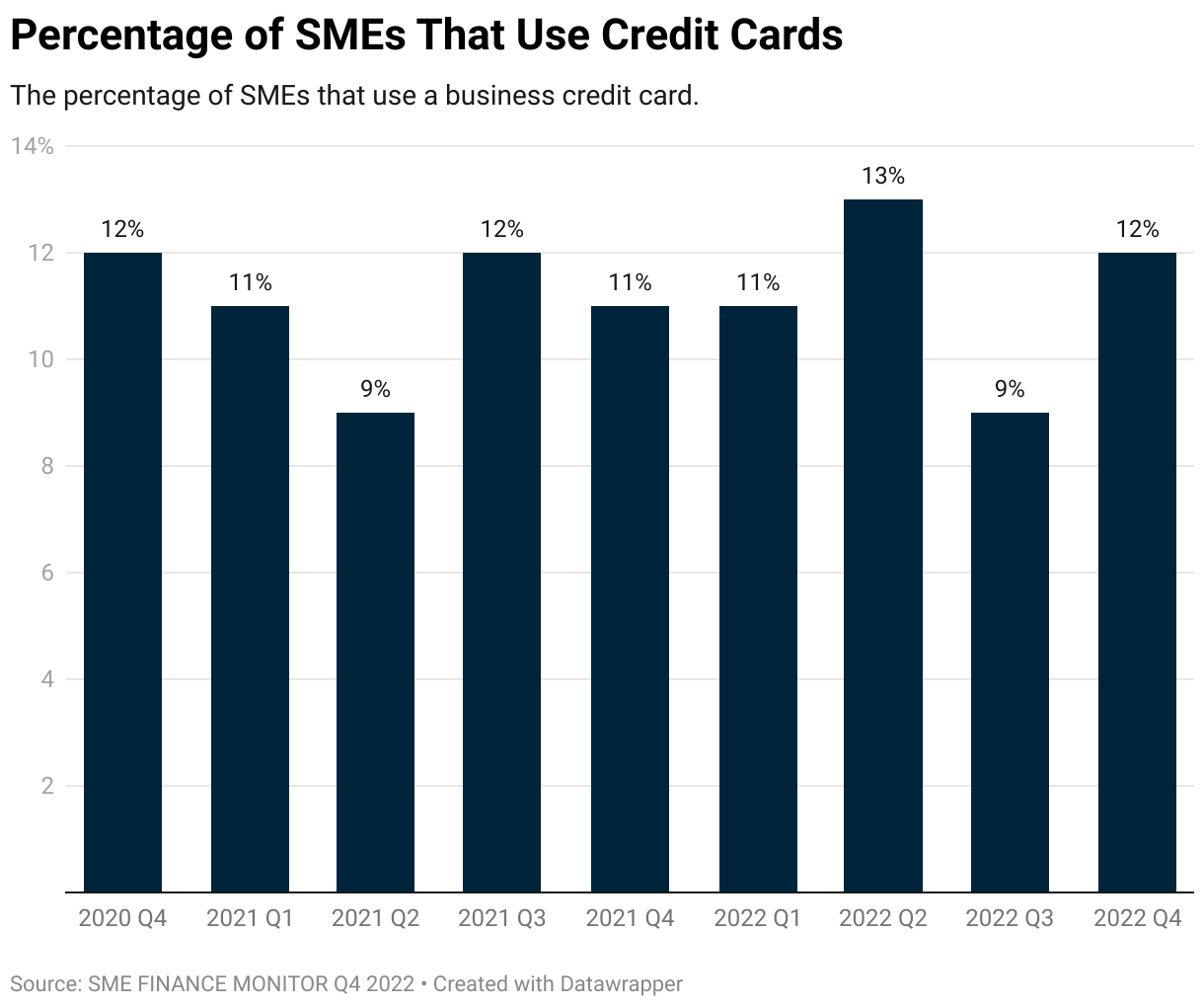
The chart below also shows how the percentage of small businesses using credit cards has varied over time since Q4 2020.